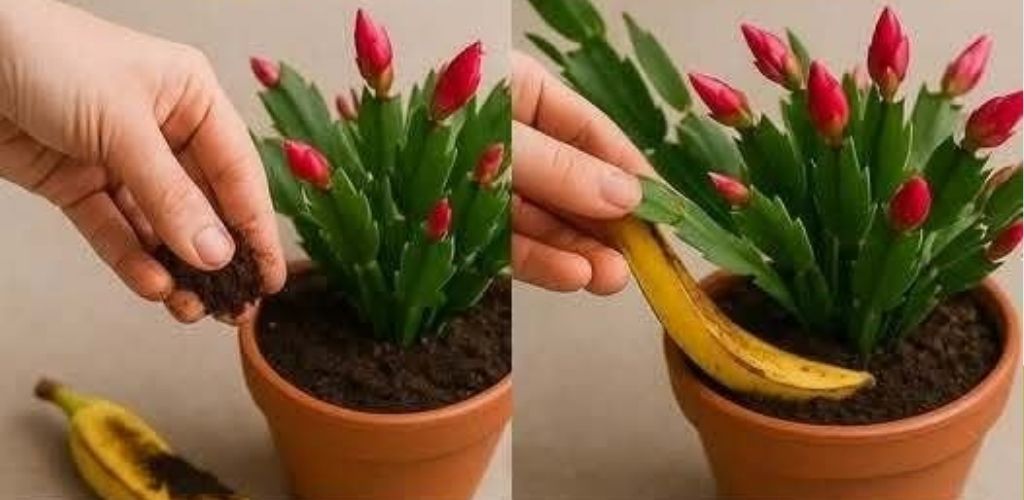
I noticed a long time ago that the Christmas cactus (Schlumbergera) won’t bloom without fertilizing. You can, of course, cool the flower by sharply lowering its temperature, but not everyone has that option.
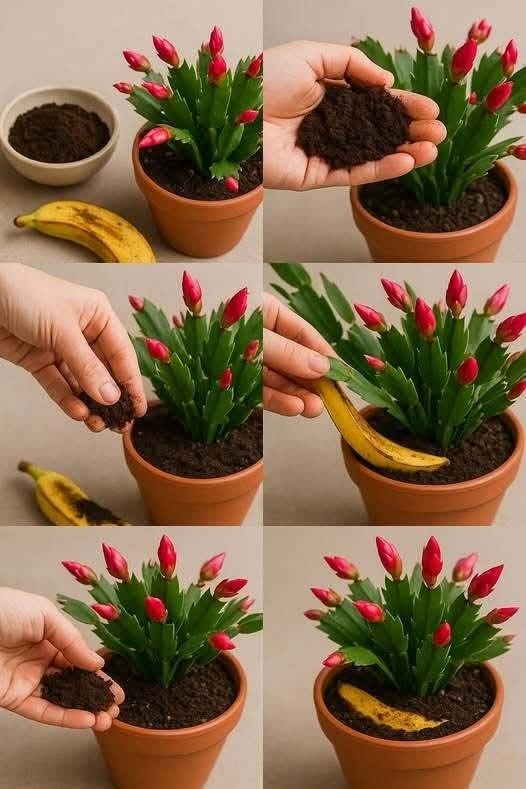
For such gardeners, I’m sharing one proven home remedy that I think every home has.
What kind of product is this?
Many will say that the Christmas cactus doesn’t need feeding. But judge for yourself: over the years, it absorbs all the nutrients from the limited soil in its pot.
Without fertilizer, the Decembrist is unlikely to bloom.
How then does a plant survive, much less thrive? You can’t get very far on water alone.
Repotting your Christmas cactus every year is a good idea. The soil is renewed, and new vitamins are added.
But what about those whose Schlumbergera is already 10 years old, and it’s no longer a flower, but a bush that’s difficult to move, let alone transplant. And the Decembrist can live for 20 years or more.
In such cases, only fertilizer will help. You can buy ready-made fertilizer at the store, but I can’t advise you on that.
I’ve never used any and can’t even suggest any names. I’m increasingly in favor of organic fertilizers, both in the garden and for houseplants.
I have a special recipe specifically for the Decembrist, which I don’t even remember where I learned it from, but I’ve been using it for a long time.
I tried it once, noticed the effect, and now I only feed it this way. This feed is made from green tea, which I think almost every home has.
Why green tea and not black?
Green tea contains 20% more soluble substances than black tea. Green tea is also rich in proteins, which, together with free amino acids, make up 15-26% of the tea.
It also contains compounds with antimicrobial action, as well as microelements that stimulate plant growth.
Feeding flowers with green tea promotes healthy growth of indoor plants. Green tea contains a large amount of microelements (potassium, fluorine, iodine, copper, zinc) essential for plants, as well as vitamins (C, B1, PP).
How to “water” the Decembrist with green tea
First, you need to brew green tea.
First, you need to brew the tea. Take a handful of green tea and pour boiling water over it. I do this in a regular ceramic bowl. Don’t even think about using an iron bowl, or it will react and the tea will turn cloudy.
Let the tea leaves cool completely. Then remove the tea pulp from the bowl and spread it over the surface of the potted soil, even on the protruding shoots of the Christmas cactus.
The flower won’t be harmed by contact with the tea leaves. Pour the liquid tea leaves into the pot as well. There’s no need to dilute them with additional water.
Please note! Don’t worry about gnats. I’ve tried feeding the Christmas cactus with green tea many times and haven’t noticed a single flying insect. Perhaps they don’t like green tea. However, florists often report that they do infest black tea.
After “treating” the Decembrist with green tea, leave it alone for seven days: don’t touch it, don’t move it, don’t water it (preferably, don’t even look at it—just kidding). After a week, you can check on it; your flower will be completely covered in buds.
My Decembrist after green tea
To support my assertions, I’m including a before and after photo of the flower in the article, as some readers always try to catch me in some kind of lie. It’s the same Decembrist, the same pot, the same brick wall.