The charm of transforming glass: when trash becomes design
There’s something deeply satisfying about cutting a bottle and turning it into a glass. It’s almost symbolic: what was once discarded now has a second life.
Unlike plastic, glass has an almost eternal quality. It doesn’t lose its properties when recycled and can be transformed indefinitely. However, industrial recycling consumes energy, especially for melting at high temperatures. Reusing a bottle without melting it reduces that energy footprint.
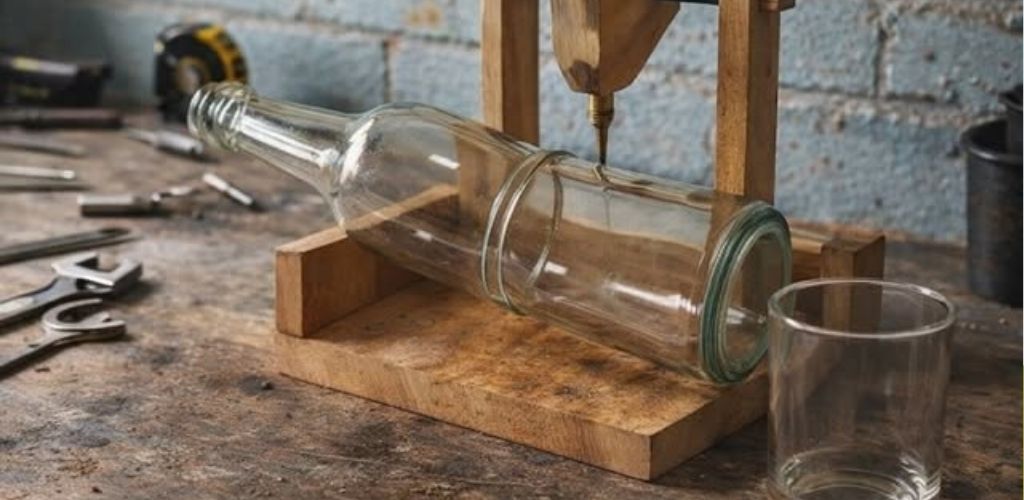
In the Kakuchi Trick video, he proposes building a homemade tool for making clean, controlled cuts. The approach is ingenious: using readily available materials to create a kind of stand that allows him to rotate the bottle while scoring it with a cutter.
It’s not a new idea—commercial bottle cutters have existed for years—but what’s interesting is the homemade, accessible, and replicable adaptation.
How glass cutting actually works
Here comes the part that many tutorials oversimplify.
Glass isn’t “cut” like wood. You can’t pierce it with a blade. You scratch the surface, creating a microscopic line of stress. Then, using heat and cold (or controlled pressure), you induce a fracture that follows that line.
In physical terms:
- Glass is an amorphous (non-crystalline) material.
- When you scratch it, you create a micro-crack.
- Thermal change generates differential expansion and contraction.
- The crack spreads along the weakest point: the striped line.
If the scoring is uneven, the cut will be uneven. If the pressure is excessive, the bottle may burst. If the cooling is uneven, lateral cracks will appear.
That’s why the stable tool shown in the video is key: stability = precision.
What the video does well (and what we could improve)
✔️ Successes
- Accessibility: Use simple materials.
- Visual clarity: the process is easy to understand.
- Creative approach: inspires reuse.
- Encourage experimentation: eliminate the fear of “I am not an expert”.
⚠️ What needs further investigation
- Real safety: glass generates almost invisible microfragments.
- Professional finish: it’s not enough to just cut; you have to sand properly.
- Bottle type: not all behave the same.
- Thermal risk: poorly controlled thermal shock can be dangerous.
This is where we can add practical value.
Not all bottles are the same
A common mistake is thinking that any bottle will do.
Recommended bottles:
- Standard wine (relatively uniform glass)
- Straight-walled liquor
- Thick beer
Problematic bottles:
- Very thin glass
- Tempered glass
- Bottles with thick embossing
- Glass with internal stresses
Interesting fact: some industrial bottles have residual stresses from rapid cooling at the factory. This makes cutting unpredictable.
Safety: the part that should never be omitted
This is where we need to be serious.
Working with glass involves:
- Goggles
- Heavy-duty gloves
- Wet sanding
- Stable surface
- Meticulous subsequent cleaning
Glass dust is abrasive. It is not toxic like asbestos, but it can cause eye and respiratory irritation.
If anyone wants to do this project with children, they must be fully supervised. It is not a school craft project.
Comparison: Homemade tool vs. commercial cutter
| Aspect | Homemade tool | Commercial cutter |
| Cost | Low | Half |
| Precision | It depends on the assembly | High |
| Durability | Variable | High |
| Personalization | High | Low |
| Experience | More artisanal | More technical |
A homemade tool has something a commercial product doesn’t: identity. It’s your creation. But it requires patience.
The finish: where quality is defined
Many projects fail here.
After cutting, the edge is dangerous. To make it a functional cup, you must:
- Sand with coarse grit (80–120)
- Continue with medium grain (220–400)
- Finish with fine grit (600+)
- Sand underwater to avoid dust
- Slightly round the top edge
If you don’t do this properly, the glass can cut your lips.
A pro tip: use wet metal sandpaper and constantly rotate the glass to maintain symmetry.
Fashion or true sustainability?
Here comes the controversial part.
Many DIY recycling projects end up decorating shelves with no real use. If you produce ten glasses that no one uses, are you really helping the planet?
Sustainability is not just about reusing. It’s about reusing with purpose.
A well-made glass can last for years. A poorly made one will end up in the trash.
The real value lies in the intention and quality of the result.
A brief history: the art of recycled glass
Cutting recycled glass is not new. In the 1970s, during energy crises, many people reused containers out of necessity, not for aesthetic reasons.
In countries with less access to industrial recycling, transforming bottles into glasses was common practice.
What we call DIY today was once survival.
Real-life example: when recycling becomes identity
I visited a small restaurant that served water in glasses made from cut-up wine bottles. They weren’t perfect. Some had slight variations. But that was part of the charm.
The customer didn’t see a glass: he saw a story.
That’s the difference between object and experience.
Practical tips if you want to do it right
- Practice first with ordinary bottles.
- Don’t press too hard on the cutter.
- Make a single, firm, and continuous line.
- Use constant hot water (not intermittent).
- Cool with cold water immediately afterwards.
- If it doesn’t cut the first time, don’t force it; try again.
- Sand more than you think you need to.
- Test the edge with your fingertip before using it.
Patience > strength.
Beyond the glass: real possibilities
- Pendant lamps
- Candleholder
- Small flowerpots
- Dispensers
- Desk organizers
- Decorative bases for workshops
Glass has a natural aesthetic presence. It doesn’t need excessive painting.
The emotional side of DIY
There is something intimate about making your own tool to make something else.
It’s almost philosophical.
First you build the environment. Then you build the object. Finally you build the experience.
That’s what the Kakuchi Trick video awakens: curiosity.
It’s not just about cutting glass. It’s about understanding materials.
Is it worth a try?
Yes… but with respect for the process.
It’s not magic. It’s not instantaneous. It’s not perfect the first time.
It’s trial, error, improvement.
And that’s where the beauty lies.
Final thought: glass does not forgive improvisation
Glass is fragile, but also unforgiving.
It forces you to work with precision. It teaches you that excessive pressure breaks you. That patience guides the fracture.
In a fast-paced world, cutting a bottle can become a silent lesson about balance.
The real transformation isn’t in the finished piece. It’s in the moment you understand how the material behaves.
And perhaps, just perhaps, that’s what makes a simple tutorial more profound than a weekend project.
Now I ask you: Would you do it for fashion… or for the pleasure of understanding how glass works?
That’s where the conversation begins.